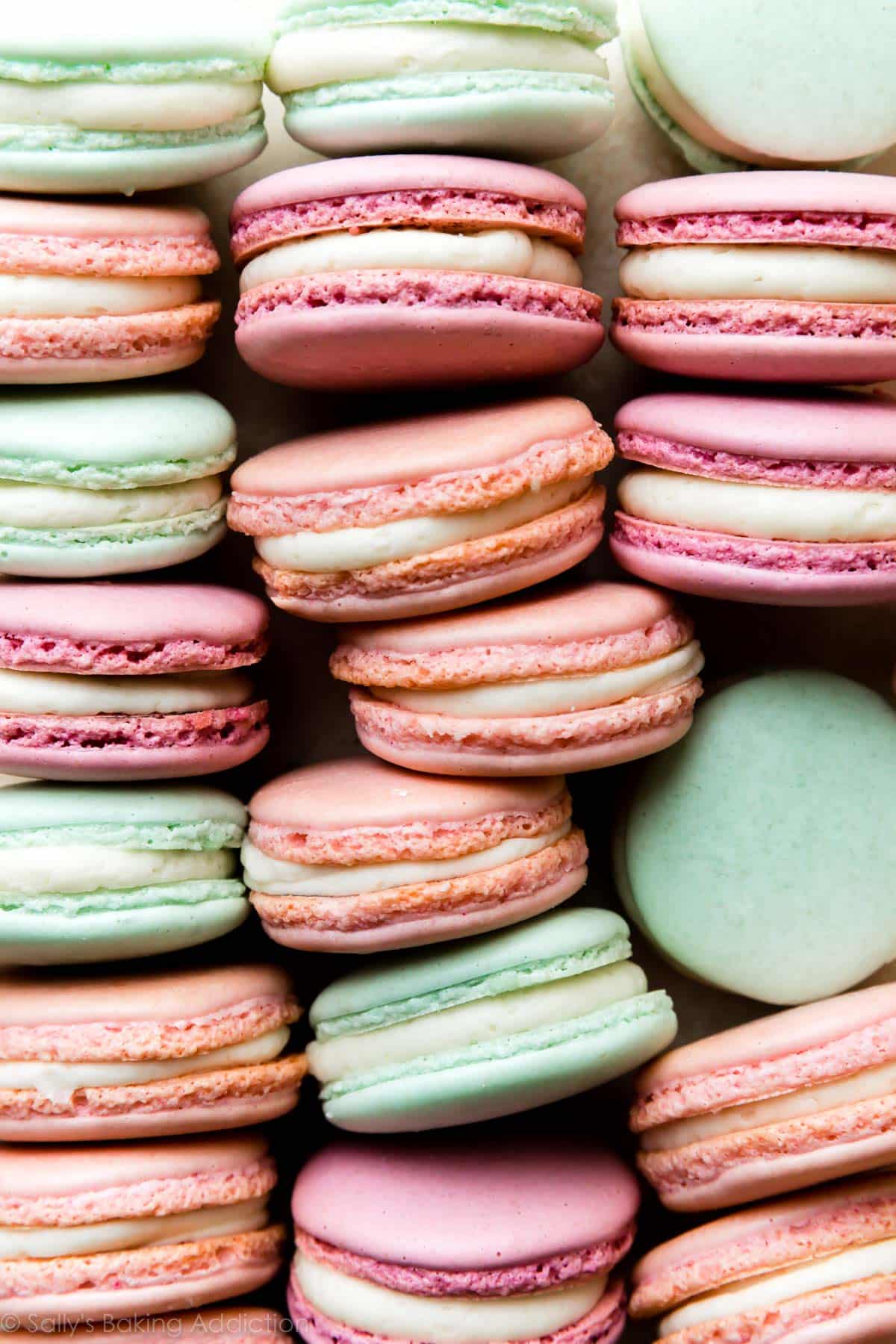
Chocolate Macarons
Ingredients
For the ganache filling
- 1/2 cup heavy cream
- 3/4 cup dark chocolate chips
For the macaron shells
- 1 1/4 cups (100g) blanched almond meal
- 3/4 cup (80g) powdered sugar
- 1 tablespoon cocoa powder
- Distilled white vinegar, for cleaning the bowl
- 2 or 3 large (80g) egg whites, at room temperature
- 1/4 teaspoon cream of tartar
- 1/3 cup (80g) sugar
Instructions
- 1
Make the ganache - In a small pot, add the heavy cream. Heat it over medium-high heat for about 5 minutes. As soon as it comes up to a gentle boil, remove it from the heat.
- 2
Make the ganache - In a medium heatproof bowl, add the chocolate chips. Carefully pour the hot cream over the chocolate and allow it to sit for 1 minute. Whisk it until fully combined and smooth. Set it aside while you make the shells. Do not put in the fridge!
- 3
Make the shells - Place a sifter or fine mesh sieve over a large bowl. Add the almond meal, powdered sugar, and cocoa powder to the sifter or sieve and sift into the bowl. Discard any large pieces of almond meal. Set the dry ingredients aside.
- 4
Make the shells - Dampen a paper towel with a bit of vinegar and wipe down the inside of a 4- or 5- quart mixing bowl. A glass or metal bowl would work!
- 5
Make the shells - Add the egg whites to the mixing bowl and using a stand mixer or handheld mixer, whisk on medium-low speed for 1 to 2 minutes until the egg whites are foamy, but not yet holding their shape.
- 6
Make the shells - Add the cream of tartar first and continue whisking for 3 minutes. At this point, the egg whites will have gained a little bit of volume, look dull, and will not hold its shape.
- 7
Make the shells - With the mixer still running, sprinkle in the sugar slowly, 1 tablespoon at a time. When all the sugar has been added, increase to medium speed and continue whisking for about 2 minutes. The egg whites will have increased in volume, become white, and look thick.
- 8
Make the shells - Continue whisking for 3 minutes until the mixture looks glossy and starts to pull away from the sides of the bowl. You will notice some ridges in the middle near the whisk indicating it is ready.
- 9
Make the shells - Stop the mixer, lift the whisk from the egg whites, and turn the whisk upside down. It should have a stiff peak of meringue that slightly bends at the very tip, but it should not slide off the whisk. If the peak curls or falls over then continue whisking the meringue, about 1 to 2 minutes. If the meringue starts to look chunky or curdled, the egg whites have been overwhipped and you'll have to start over.
- 10
Make the shells - Add one third of the dry ingredients into the meringue. Using a rubber spatula, gently fold them together. Repeat with the remaining dry ingredients, one third of it at a time until fully combined.
- 11
Make the shells - Use a rubber spatula to scrape the batter against and around the sides of the bowl to knock some of the air out of the batter. Do this 5 or 6 times. Knocking some of the air out of the batter is important because too much air will cause the shells to crack while they bake.
- 12
Make the shells - Use a rubber spatula to pick up some of the batter and drizzle it over the batter in the bowl. It should stream down like honey. Draw a figure 8 with it over the batter. The figure 8 should start to sink back into the batter after 10 to 20 seconds, but not disappear. If the batter does not pass the figure 8 test, fold the batter with a rubber spatula twice and then check it again, and repeat until it passes!
- 13
Bake the shells - Turn two large baking sheets upside down and line the bottom of the baking sheet (which is now the top!) with a silicone baking mat or parchment paper. Set them aside. Fit a 12- to 18- inch pastry bag with a small round pastry tip—I use a small #12 Wilton round tip.
- 14
Bake the shells - Use a rubber spatula to gently scrape the batter into the piping bag. Twist the top of the pastry bag so that the batter doesn't fall out of the bag while you're holding it. If using parchment, pipe a small dot of batter in each corner of the baking sheet to help secure the paper.
- 15
Bake the shells - Pipe 1- to 1 1/2-inch circles 2 inches apart from each other on the prepared baking sheets. The pastry tip should point directly down, not at an angle, for evenly sized and perfectly round shells. If the tops have a pointy tip from the piping, gently smooth them out with an offset spatula or the back of a small spoon. You will get 30 to 32 circles, which will yield 15 or 16 macarons.
- 16
Bake the shells - Firmly grasp the sides of the baking sheet and tap it hard against your counter. Tiny air bubbles may come up to the surface of the shells and pop. You can use the sharp pointy end of a toothpick to pop them, if desired. Rotate the baking sheet as needed to tap all sides evenly.
- 17
Bake the shells - Allow the shells to rest for 30 to 40 minutes. It may take up to 1 hour if your home is humid. The shells are ready to bake when they look matte and you can touch the tops without them sticking to your finger or leaving a mark.
- 18
Bake the shells - Place the oven rack to the center of the oven and preheat it to 300°F. Bake the shells, one baking sheet at a time, for 13 minutes. When the timer goes off, carefully open the oven door, and gently touch the top of a shell. The top of the shell should not move from the feet where it touches the pan. If it moves slightly, bake it for 1 minute more.
- 19
Bake the shells - Place the baking sheet on a wire cooling rack. Allow the shells to cool completely before lifting them from the mat. Do not try and lift them up using a spatula or other tool, especially if they are sticking. Once they are completely cool, use your hands to peel the baking mat or parchment paper back from the shells slowly and gently. If they are completely cool, the shells should come off easily.
- 20
Assemble the macarons - Match up similar-sized shells in pairs and set them aside on your counter. Each pair will be filled with the chocolate ganache.
- 21
Assemble the macarons - Fit a small piping bag with a round #12 Wilton tip. Using a rubber spatula, scrape the chocolate ganache into the pastry bag. Twist the top of the pastry bag so that the ganache doesn't fall out of the bag while you're holding it. Pipe a little less than a tablespoon-sized dollop of the ganache onto one of the paired shells. Top it with its paired shell. Repeat with all other macarons.
- 22
Assemble the macarons - Transfer the macarons into an airtight container and place them in the fridge overnight, at least 12 hours, to soften for the best texture. This step is called maturing.